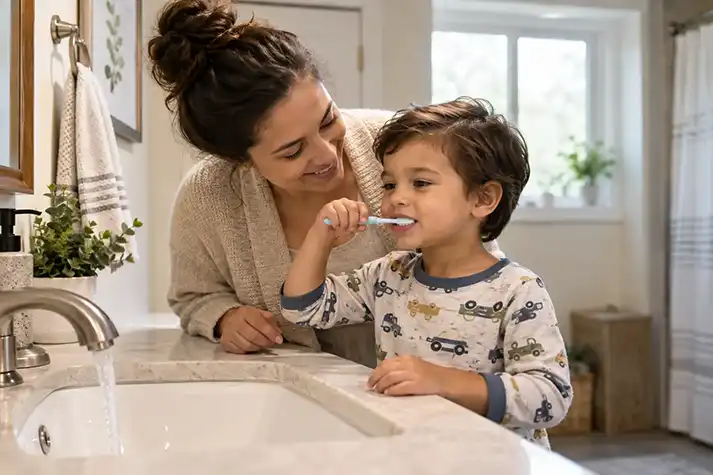
Toothbrushing is simple in theory and surprisingly complicated in a real family bathroom. A toddler clamps their mouth shut. A preschooler wants to do everything alone. A school-age child announces they already brushed, while the dry toothbrush suggests otherwise. These moments are common because brushing asks children to tolerate unusual tastes and sensations, pause something more interesting, and accept an adult’s help in a very personal space. A calmer routine begins by matching the job to the child’s actual abilities.
Begin When the First Tooth Appears
The American Academy of Pediatrics recommends brushing twice a day as soon as a baby’s first tooth comes in, usually after breakfast and before bed. Before teeth erupt, families may gently wipe the gums with a clean, damp cloth. Once a tooth appears, use a soft, child-size toothbrush and fluoride toothpaste.
The amount matters. For children younger than three, use a smear about the size of a grain of rice. For ages three through six, use a pea-sized amount. An adult should place the toothpaste on the brush, keep the tube out of reach, and help the child spit out the excess rather than swallow it. The American Academy of Pediatric Dentistry gives the same age-based amounts and emphasizes that young children cannot clean their teeth effectively without help.
The Basic Routine
Use a soft toothbrush and the correct amount of fluoride toothpaste. Brush every surface gently twice a day. Let children participate, but have an adult complete or closely supervise the job until the child has the coordination and consistency to brush well alone.
Infants and Toddlers: Comfort and Position Come First
Very young children often feel more secure when their head is supported and the adult can see clearly. A parent might sit on the floor with the child’s head resting in their lap, use a changing surface while staying beside the child, or stand behind the child at the sink. Choose a position that is stable, comfortable, and safe for both people.
Keep the sequence short and predictable: “Toothpaste, top teeth, bottom teeth, spit, all done.” A toddler can hold a second toothbrush, choose between two brush colors, or take the first turn before the adult finishes. These are real choices that preserve the necessary boundary: brushing still happens. If the child becomes overwhelmed, pause briefly, stay calm, and finish as gently and efficiently as possible rather than turning the moment into a lecture.
Preschoolers: Offer Independence Inside Clear Limits
Preschoolers are often eager to do the job themselves but do not yet have the hand control or attention to reach every surface. Try a two-turn routine: the child brushes first, then the adult “checks the back teeth” and completes the brushing. Use a timer, short song, or the same spoken sequence each day so the ending feels predictable.
Avoid asking a question when there is no real choice. “Are you ready to brush?” invites a reasonable “no.” Instead, say: “It is brushing time. Would you like the blue cup or the green cup?” Praise specific cooperation—opening wide, holding still, or remembering to spit—rather than promising that the child must enjoy every part of the routine.
School-Age Children: Transfer Responsibility Gradually
The AAP notes that children commonly need brushing help until about age eight. A useful readiness check is whether the child can manage other detailed hand tasks consistently, such as tying shoes, while still remembering the full routine without rushing. Even after a child begins brushing independently, an adult can supervise the two-minute routine and occasionally check commonly missed areas near the gumline and back teeth.
Make the expectation concrete. “Brush every surface until the timer ends” is clearer than “Brush better.” A small visual routine can help: toothpaste, outer surfaces, inner surfaces, chewing surfaces, tongue, spit, rinse the brush, put it away. If a dentist has given different directions for the child, follow that individualized guidance.
Older Children and Tweens: Keep the Routine Visible
Older children may have the physical skill to brush but still skip when they are tired, running late, or distracted. Tie brushing to dependable anchors—after breakfast and before the final bedtime activity—rather than relying on repeated reminders from another room. Keep supplies easy to find, replace worn toothbrushes, and ask the child’s dentist about cleaning around braces, retainers, or other appliances.
Supervision can become less intrusive without disappearing. A parent might stay nearby, check the timer, or ask the child to report when the routine is complete. If brushing quality slips, return temporarily to more direct support without presenting it as punishment. Independence grows through reliable practice, not simply through age.
When Taste, Texture, or Sensation Is the Problem
Some children dislike strong mint flavor, foaming toothpaste, the sound of an electric brush, or bristles touching certain areas. That discomfort is different from simple stalling. Try a soft manual brush, a milder fluoride toothpaste, a quieter setting, or letting the child explore the brush with their hand before it enters the mouth. Introduce one change at a time so the family can tell what helps.
Do not force a particular product merely because it works for another child. If brushing remains extremely difficult, causes repeated gagging, or cannot be completed despite gradual practice, ask the child’s dentist or healthcare professional for individualized strategies. Children with sensory, motor, developmental, or medical needs may benefit from adapted positioning, equipment, or a step-by-step plan designed for them.
Support Teeth Between Brushings
Brushing is one part of oral health. Frequent exposure to sugary drinks and snacks gives cavity-causing bacteria more opportunities to produce acid. Offer water between meals when practical, avoid sending a child to sleep with a bottle or cup containing anything other than water, and keep meals and snacks reasonably structured. JKD families can review the program’s general meals and nutrition information, but individual oral-health needs should be discussed with the child’s dentist or healthcare professional.
The CDC reports that children who brush with fluoride toothpaste have fewer cavities. The National Institute of Dental and Craniofacial Research also recommends twice-daily fluoride brushing with adult supervision for young children. A dentist can explain when to begin cleaning between teeth and whether fluoride varnish, sealants, or another preventive measure is appropriate.
Make the First Dental Visit Early
AAP and AAPD guidance recommends a dental visit when the first tooth appears and no later than the first birthday. An early visit gives families a place to ask about brushing, fluoride, feeding, tooth development, and their child’s specific cavity risk before there is an urgent problem.
Contact a dentist promptly for tooth pain, facial or gum swelling, a broken or injured tooth, bleeding that does not stop, or another concern that cannot wait for a routine appointment. An article cannot evaluate those symptoms. For everyday resistance, however, the most useful reset is often simple: reduce the number of words, offer one small choice, help at the child’s developmental level, and repeat the same calm routine tomorrow.