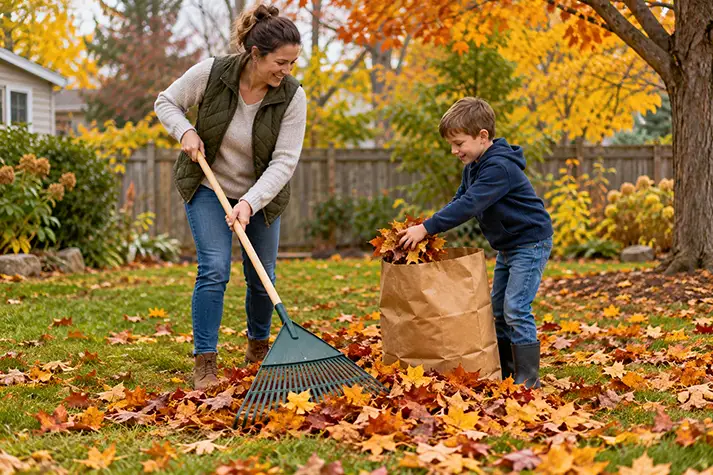
A few bright leaves can turn an ordinary yard into a place for sorting, noticing, and helping. Then the bags fill, the weather changes, and a parent needs to know when the Town of Greece will actually collect them. This guide brings the town’s 2026 leaf collection instructions together with practical ways to include children without making a yard task feel like a test of endurance.
Check Your Street Before Filling Bags
Greece’s 2026 leaf collection page says residential pickup runs from October 5 through December 2 on a two-week rotation. The date depends on your street’s assigned area, not simply on the day your usual trash is collected. Use the town page’s street search to find your area, then look at the schedule above it. Some streets are split by address range or side of the road, so check the exact listing. The town says bags must be at the curb the day before the assigned pickup to ensure collection.
The town calls for paper leaf bags. It also accepts a clearly labeled 30-gallon can with handles if the filled container weighs no more than 50 pounds. Keep plastic bags, branches, rocks, metal, and other trash out of the leaves. The town composts what it collects, and stray materials can damage the equipment and contaminate the compost. A quick adult check before tying each bag matters more than trying to finish fast.
Two-Minute Pickup Plan
Look up your exact street and address range, note the next pickup date, gather paper bags, and decide where the adult will stage filled bags. Recheck the town page if weather changes the plan. Keep children with the adult in the yard while bags are moved toward the curb.
Give Children a Job That Fits Their Age
For babies, the useful role is observation. Let an infant watch the colors from a stroller or an adult’s arms while another adult handles the work. Do not place babies in a leaf pile: it can hide sticks, debris, insects, or an uneven surface. A mobile toddler might carry one clean leaf to a bucket, compare colors, or help pat down a small pile well away from the curb. Stop when the child loses interest.
Preschoolers can gather a few leaves with their hands or a child-size rake, count handfuls, and help hold a bag open while an adult fills it. Older children can rake a defined patch, check for unwanted objects, or help choose which leaves to save for a craft. A tween may be ready to find the street’s pickup area on the town page, mark the calendar, and help plan the sequence. Adults still decide whether a tool, bag weight, or roadside step is appropriate.
Keep the task short and specific: “Let’s clear the path from the steps to the sidewalk,” works better than “Finish the whole yard.” Offer a break, warm drink, or a different job when hands get cold. JKD’s age-appropriate chores guide has more ideas for teaching a task one step at a time. The leaf project can end after ten useful minutes and still count as contribution.
Keep Play and Cleanup Away From Traffic and Machines
Set a visible boundary before work begins: children play and collect leaves in the yard, away from the street, driveway, parked cars, and the place where bags will wait for pickup. Even a quiet neighborhood road has turning vehicles and drivers whose view may be limited by parked cars or low autumn light. Adults should handle curb placement. Never let a child hide in a roadside leaf pile or run through one; a driver may not see them, and the pile may contain hard or sharp objects.
If a mower, leaf vacuum, or blower is being used, move children to a separate supervised activity first. The American Academy of Pediatrics advises keeping children away from operating lawn mowers; thrown debris and moving parts can injure even a child who is only watching. Rakes can also catch feet and faces when children swing them. Demonstrate how to carry a rake with the tines down, leave space between workers, and set it flat when taking a break.
Think About Ticks, Damp Leaves, and Cleanup
Leaf litter can provide tick habitat. The CDC recommends checking children for ticks after outdoor activities, including time in the yard, and notes that ticks can be active whenever temperatures allow. Dress for the weather, use gloves when handling damp leaves, and wash hands afterward. If a child develops a concerning rash or illness after a possible tick bite, contact a health professional for individual advice. This article cannot tell whether a particular bite carries an infection.
Skip leaf play where you cannot see what is underneath, especially at the curb or in a long-neglected pile. Check a small play area for broken glass, animal waste, sharp sticks, and holes. Dry clothes and shoes after a wet afternoon. The goal is to let children enjoy the season with a little foresight, not to make every leaf seem dangerous.
You Do Not Have to Bag Every Leaf
Families with a garden may choose to use some dry leaves as mulch or compost. The U.S. Environmental Protection Agency lists dry leaves among materials that can be composted at home and recommends yard waste as mulch or compost where suitable. Keep walking paths clear and avoid letting damp layers smother a lawn or block drains. A small, intentional garden pile is different from leaving leaves where a child needs to walk or where stormwater must flow.
If the family has more leaves than it can manage before its pickup date, Greece also lists four seasonal drop-off sites and a year-round yard waste facility on Flynn Road. Check the town’s current directions before driving there. It says not to leave plastic bags, brush, or containers at the leaf drop-off sites. An adult can choose whether pickup, drop-off, composting, or a combination makes the most sense for the household.
End With Something Children Can Notice
Before going inside, ask what changed: Is the path easier to walk? Which tree dropped the most leaves? Did the pile feel light when dry and heavy when wet? A child can draw one leaf, save a clean one for a rubbing, or help mark the next pickup on the calendar. Those small observations make the task feel connected to the place the family lives.
Greece’s collection program offers a practical deadline, but a family does not need a perfect yard or a perfectly cheerful helper. Choose a safe patch, match the job to the child, and let the adult carry the responsibility for the schedule and the curb.