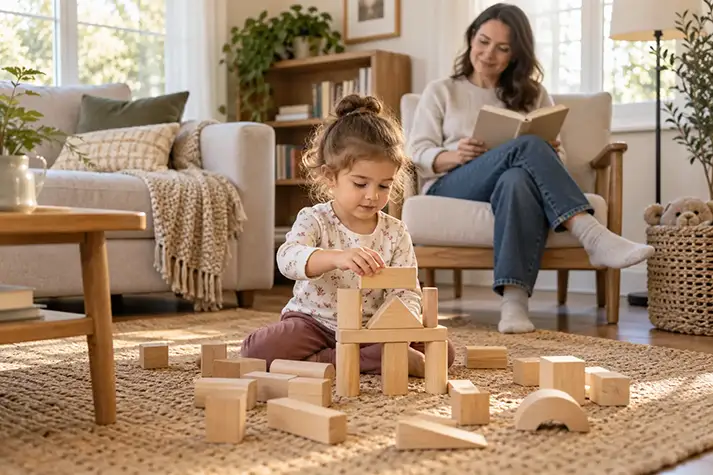
A child who asks an adult to play is not failing at independence. Children are social learners, and connection with a trusted adult gives them a secure starting point for exploration. Independent play grows when adults offer that connection, make the environment safe and manageable, and then leave enough room for the child to decide what happens next. The goal is not to make children stop needing us. It is to help them become more comfortable carrying an idea forward on their own.
What Independent Play Really Means
Independent play is child-directed activity that does not require an adult to supply constant instructions or entertainment. A baby may examine a soft toy while a caregiver stays within reach. A toddler may move blocks from one container to another. A preschooler may create an elaborate pretend restaurant, and a school-age child may draw, build, read, write a story, or work on a personal project. The adult remains responsible for safety and is available when genuinely needed, but the child owns the play.
The American Academy of Pediatrics describes self-directed or free play as important for children’s exploration, interests, agency, problem-solving, and developing ability to focus. That does not mean every quiet activity must produce a measurable skill. Play is valuable partly because children choose it and become actively engaged in discovering what their ideas can do.
Independent Does Not Mean Unsupervised
Match supervision to the child, the materials, and the setting. Babies and young children need an attentive adult nearby. Water, climbing, outdoor areas, choking hazards, tools, cooking, and other higher-risk activities require direct adult oversight regardless of how confidently a child plays.
Start With Connection, Then Step Back
Many children settle more easily after a brief period of warm attention. Sit together, notice what the child is interested in, and join without taking over. You might stack two blocks, read one short book, or help arrange toy animals. Then tell the child what you will do nearby: “I’m going to put away the dishes while you keep building. I’ll check back when I’m finished.” A predictable return feels different from abruptly disappearing.
For a child who usually wants constant participation, begin with a period they can succeed at and expand gradually. There is no universal number of minutes that proves a child is doing well. Temperament, age, fatigue, hunger, recent transitions, and familiarity with the materials all matter. Success may begin as one focused minute for one child and a much longer stretch for another.
Infants: Safe Exploration With an Adult Close
For an awake infant, independent play might mean lying on a firm floor space and looking, reaching, rolling, or exploring one safe object while an adult watches closely. The CDC encourages floor play and exploration while babies are alert and relaxed, along with responsive talking and breaks when a baby becomes tired or fussy. A caregiver can comment briefly—“You found the ring”—and then pause rather than continually repositioning the object or trying to hold the baby’s attention.
Use objects that are intact, washable, and too large to be choking hazards. Keep cords, plastic bags, button batteries, magnets, hot drinks, pets, and unstable furniture away from the play area. Awake floor play is separate from sleep; follow safe-sleep guidance for every nap and night. Families wanting more ideas for active infant play can review JKD’s tummy time guide.
Toddlers: Reduce Choices and Keep the Adult Nearby
Toddlers often move rapidly between activities. That is not a sign that play is “too short.” Offer one or two simple options instead of opening every bin at once: large blocks and toy animals, cups for stacking, chunky puzzles, washable crayons, or pretend kitchen items. CDC guidance encourages toddlers to explore, try new things, participate in pretend play, and have frequent opportunities for free play.
Stay in the same room or within the safe supervision needed for that child. If the toddler hands you a toy, acknowledge it without automatically becoming the director: “You brought me the blue block. Where will it go?” If frustration rises, offer the smallest useful help—a block turned upright, a lid loosened, or words for asking—then give the activity back. Families can also explore JKD’s guide to supporting toddlers through big feelings.
Preschoolers: Make the Beginning Easy
Preschoolers may have plenty of ideas once they begin but struggle with the transition into play. Set out a simple invitation rather than announcing a complicated project: paper and a few crayons, blocks beside two toy vehicles, play dough with a rolling pin, or dress-up items in one basket. CDC guidance recommends letting preschoolers choose what to play and giving a limited number of simple choices.
Try a clear boundary with a visible ending: “I’ll sit with you for five minutes, then I’m going to fold laundry while you decide what happens to the castle.” A timer can help some children, but it should mark the adult’s predictable return, not pressure the child to perform. If the play is going well when the timer ends, let it continue.
School-Age Children and Tweens: Protect Unscheduled Time
Older children may say they are bored because their days are highly scheduled or because screens provide an immediate next idea. Avoid treating boredom as misbehavior. A calm response—“You don’t know what to choose yet; I’m confident you’ll find something”—leaves responsibility with the child while keeping the relationship warm.
Offer access to materials that match real interests: books, sketch supplies, building sets, music, puzzles, journals, craft materials, or safe household projects. Some children prefer solitary play; others are more engaged beside a sibling or adult who is doing a separate task. Independent play does not have to happen in isolation. A child can work on their own idea while still enjoying quiet companionship.
Arrange the Space for “Yes”
A workable play space does not need to be large or expensive. It needs to be safe enough that the adult is not interrupting every few seconds. Store a manageable number of materials where the child can reach them, keep pieces together, remove broken items, and rotate options when the area feels crowded. Open-ended materials—blocks, paper, figures, fabric, boxes, and age-appropriate art supplies—can support many ideas without a single correct result.
- Choose materials the child can use safely and mostly manage without help.
- Offer fewer visible choices when the child seems overwhelmed.
- Keep favorite materials accessible and rotate some less-used items.
- Place the play area near ordinary family activity when the child wants company.
- Expect setup and cleanup to need more adult help than the play itself.
Know When to Join Again
Step in when safety is at risk, the child asks for help they truly cannot manage, or frustration has replaced exploration. When the problem is merely a pause, resist solving it immediately. Ask one light question—“What could you try next?”—or describe what you notice. Too many suggestions can turn the activity back into an adult assignment.
Children also need shared play, conversation, reading, movement, and friendship. Independent play is one part of a balanced day, not a replacement for responsive care. If a child’s play, communication, movement, or behavior raises a developmental concern, discuss it with the child’s healthcare professional rather than using play duration as a diagnosis. The most useful measure is not a stopwatch. It is whether the child is gradually becoming more able to explore, make choices, persist through small problems, and reconnect with confidence.