Cold rain, early darkness, and icy patches can shrink a family's outdoor plans around Greece and Rochester. Children still need chances to move, but an indoor day does not require a miniature gym or an elaborate craft supply closet. A clear patch of floor, a few familiar objects, and short invitations to play can go a long way.
Think in small bursts, not one long workout
The CDC advises that children ages 3–5 be active throughout the day, while children ages 6–17 get at least 60 minutes of physical activity daily. Those are broad public-health goals, not a demand that every family stage a formal exercise session in the living room. Movement can come in pieces: a dance after breakfast, a hallway walk before lunch, a game after school, and a trip outside when conditions allow.
A useful question is, “What can my child safely do in the space we have today?” In an apartment or a home with downstairs neighbors, gentle balance games may fit better than jumping. A child recovering from illness or living with a disability may need a different pace or adapted activity. Follow any individualized guidance from the child's clinician or therapist.
Babies: room to look, reach, and explore
For an infant, movement may be as simple as looking toward your face, reaching for a safe toy, kicking on a play mat, or rolling when ready. Place a baby on a firm, clear floor surface and sit close enough to respond. You can move a toy slowly from one side to the other or talk from different positions so the baby has a reason to turn and look. Follow the baby's cues and take a break when they need one.
The American Academy of Pediatrics recommends supervised tummy time while babies are awake; babies should still be placed on their backs for sleep. Families looking for more detail can use our practical tummy-time guide. Keep small objects, cords, unstable furniture, and older children's tiny game pieces outside the baby's play area.
Toddlers: give movement a simple purpose
Toddlers often enjoy a task more than an instruction to “exercise.” Ask them to carry a soft toy to a basket, walk around two cushions, or bring a scarf to the sofa. Try a slow follow-the-leader walk: tiptoe, march, stretch up, then crouch down. Put on one song and move together until it ends. The AAP suggests familiar games such as dancing, hide-and-seek, and moving like animals for indoor toddler activity.
Keep the route low to the ground and free of sharp corners. A pillow is a stepping marker, not a platform from which to leap. Toddlers need an adult nearby, especially around stairs, doorways, and furniture that could tip. If the room is small, repeat one safe route rather than making a bigger obstacle course.
Preschoolers: turn a room into a game
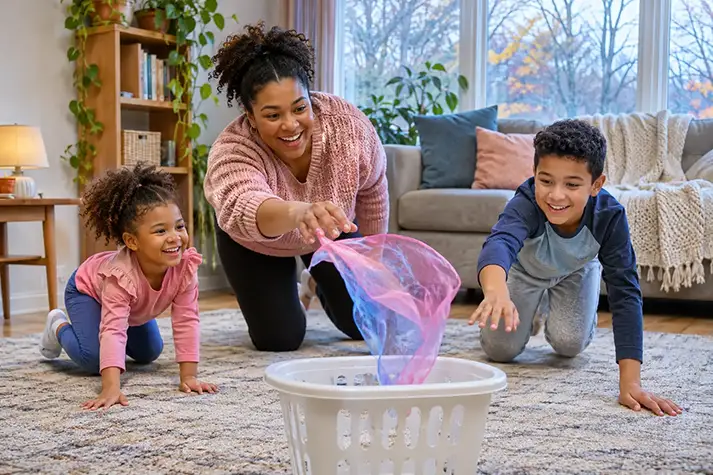
A preschooler can help invent movement rules. Call out “bridge” for a wide stance, “tree” for standing tall, and “mouse” for a quiet crouch. Play a slow version of follow-the-leader or ask the child to deliver stuffed animals to different “homes” around the room. Toss rolled-up socks into a laundry basket from several distances. Let the child choose the next motion so the game stays playful instead of turning into a test.
For siblings of different ages, give each person a version that fits. A younger child may carry one toy while an older child creates the route. Make clear that racing past a baby, wrestling near furniture, or throwing hard objects is outside the game. Five enjoyable minutes can be easier to repeat tomorrow than a complicated hour everyone resists.
School-age children and tweens: give them a say
Older children may reject a game designed for little kids. Invite them to make a playlist for a family dance break, teach a favorite stretch, set up a soft-ball target, or design a walking-and-balance challenge that works in your home. Chores that involve safe movement—putting away laundry or tidying a room—can add activity, though they need not replace enjoyable play. If a child prefers a quiet start, offer a choice between two ideas rather than demanding an enthusiastic performance.
The CDC's daily activity guidance for ages 6–17 includes more vigorous movement and activities that strengthen muscles and bones. A cramped living room cannot provide every kind of activity safely. When weather and schedules permit, pair indoor movement with outdoor walks, recreation programs, or other spaces suited to running and jumping. A child's interests matter more than making every day look identical.
A 15-minute indoor reset
Clear the floor together. Spend five minutes moving to music or following a route, five minutes on a child-chosen game, and five minutes slowing down with stretching, a story, or water. Shorten, extend, or adapt the plan to the child and the room. The point is a repeatable invitation, not a score.
Two Greece places to keep in mind
For a change of setting, The Center at 3 Vince Tofany Boulevard lists a walking track and a Toddler Gym for ages 0–5. The town says the Toddler Gym is for Greece residents who are members of The Center; socks are required for children and adults. Check current access and hours before going. For older children, look at the town's current recreation offerings rather than assuming the toddler space fits them.
The Greece Public Library's Story Garden offers books and imaginative play areas. It is a gentler outing than a gym, but a child can still explore and move while sharing time with an adult. Check the library's current hours and events. Our separate library guide has more ideas for making a visit worthwhile.
If your family needs childcare
A change in work hours, school schedules, or family plans can create a childcare question in any season. If you need care for a day, a week, or longer, contact Jenny at Jasmine's Kingdom Daycare to ask what may be available for your child's age and schedule. Those are inquiries, not promises of a particular arrangement or immediate start. Any care depends on current availability and suitability, required approvals and paperwork, agreed payment or assistance terms, and a confirmed start date. You can also review enrollment information and schedule a tour before deciding what fits your family.
Keep a small menu ready for the next indoor day
Write down three games that worked and where the supplies live: perhaps a song, a basket and soft socks, and a favorite follow-the-leader route. Rotate them instead of introducing something new every hour. If the weather improves, outdoor play can return; an indoor plan simply gives the family a practical option when it does not. Children notice the invitation to play together more than the sophistication of the equipment.