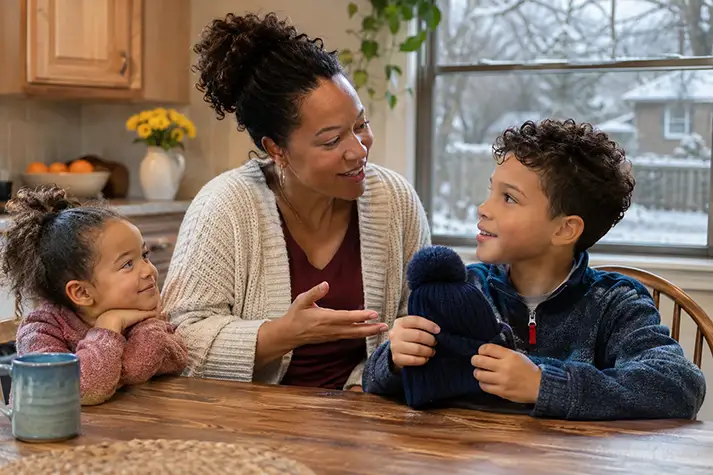
A school closure can sound exciting to a child and feel complicated to the adult rearranging work, transportation, and care. In Greece, NY, winter weather may bring a full closure, a delayed start, or an early dismissal. A useful family plan answers three questions before the forecast gets urgent: Where will we get the official update? Who will be with each child? What will we do if the plan changes again?
Start with the district’s actual decision
A forecast is a reason to prepare, not an announcement that school is closed. Greece Central School District’s 2026–27 district safety plan says it may close all schools or an individual school, delay the start, or dismiss early, depending on conditions. The plan says closure notices are posted on the district website and reported to local radio and television; an automated phone call informs families whenever possible. Check the district’s current notice and your own school’s communications before changing your child’s day.
Make sure the school has your current phone number, your alternate contact, and the adults authorized to pick up your child. If your child attends a different district, private school, preschool, or childcare program, confirm that organization’s decision separately. Do not assume its schedule matches Greece Central’s. A delay and an early dismissal call for different plans, so read the exact wording instead of relying on a social-media repost.
The five-minute plan
Save the school’s official news page. Check your contact and pickup information. Name a first and second adult for each child. Agree where children will wait if school ends early. Put the plan somewhere every caregiver can find it.
Decide who does what before the first snow day
Write a short Plan A and Plan B, even if both adults usually work from home. Who can stay with the children if school closes? Who can pick them up if the bus schedule changes? Who calls a grandparent, neighbor, or other trusted person? Ask the backup adult in advance; being listed as an emergency contact does not mean they are free that day. Share any allergies, medication instructions, contact numbers, and the child’s usual routines through the appropriate caregiver channels.
Think through siblings separately. A school-age child may be home while an infant’s childcare follows its normal schedule, or the reverse. Ask each school or provider about its own weather communication and pickup process. If your work schedule is rigid, learn now whether an employer permits a schedule change or remote work; do not wait until everyone is awake and wondering what happens next.
For an early dismissal, tell school-age children which approved adult will meet them and where they should go if that person is delayed. Keep the explanation simple and repeat it occasionally. The American Academy of Pediatrics advises families to keep schools supplied with up-to-date pickup and care contacts. A plan written down is easier to use when phones are busy and adults are working in different places.
Tell children what is known, by age
Infants and toddlers do not need an explanation of district decisions. They need a familiar adult, meals, rest, and comforting transitions. If their caregiver changes for the day, allow time for a calm handoff and pass along the essentials. A toddler may hear “Today you’ll stay with Grandma. I’ll come back after work” more easily than a long account of the weather.
Preschoolers understand a concrete plan: “School is closed today because the roads may be slippery. We’ll have breakfast here, then Aunt Lee will be with you while I work.” Say when you will check again if plans are uncertain. Offer a familiar book, snack, or rest period rather than promising an elaborate special day you may not be able to deliver.
Elementary-age children can help remember the two trusted adults and the place to meet after an early dismissal. Invite questions about canceled activities or assignments. If their school sends learning instructions, read those together; a school closure does not automatically mean every class, activity, or task works the same way.
Older children and tweens may want more independence, but spell out the boundaries: who is home, how to reach an adult, whether they may go outside, and when to check in. Let them help plan a meal or message a relative. Age alone does not decide whether a child should stay home without an adult; consider the child, conditions, family arrangements, and applicable rules.
Keep the day recognizable, even if it is flexible
A surprise day at home does not require a minute-by-minute schedule. Try three anchors: a usual wake-up and meal rhythm, some time to move or play, and a familiar bedtime. If an adult needs to work, be honest about when they can give full attention. The AAP’s school-break guidance notes that a regular routine can help children when school is not in session. For movement ideas that fit small spaces, see our indoor movement guide.
Let a disappointed child be disappointed. A canceled performance, game, or visit matters to them even if the adult is relieved to stay off the road. “I know you were looking forward to it” can come before “Let’s see whether it will be rescheduled.” Avoid telling children a closure is definitely coming before the district announces it; uncertainty is easier when adults say what they know and what they are checking.
Make the travel decision separately
School being open does not make every driveway or route safe. Check current National Weather Service winter alerts, your own route, and the conditions where your child waits or walks. A delayed start can change a family’s work departure and pickup plan. If travel is necessary, allow time to clear the vehicle and reassess as conditions change. The Town of Greece’s winter operations page also explains its overnight parking rule, in effect November 1 through April 15, so plows can work on Town roads.
When your family decides a trip is unsafe, contact the school or caregiver through its normal channel. Keep the focus on this day’s decision, rather than trying to predict the whole winter. If a storm also interrupts power or heat, use a separate family power-outage plan; a closure plan addresses the people and schedule first.
Review the plan before you need it
Take ten minutes on an ordinary evening to ask each caregiver, “If tomorrow starts late, closes, or ends early, who does what?” Update the names and numbers when jobs, schools, or family circumstances change. Children do not need a perfect snow day; they need adults who know where to find the facts, how to reach one another, and who will be there for them.