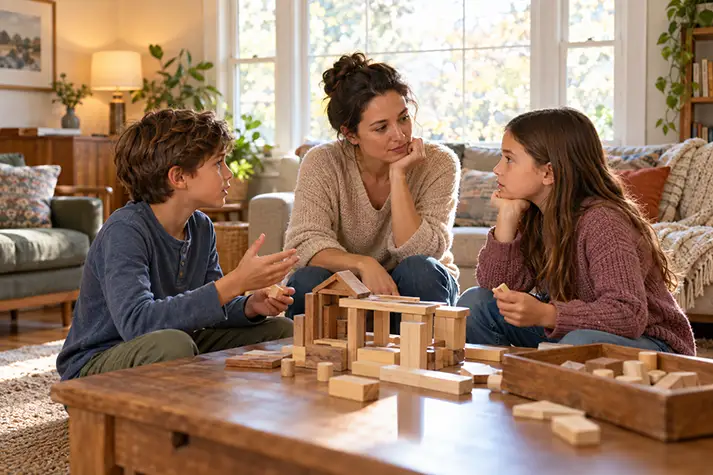
Two children can love each other, enjoy the same games, and still argue fiercely about who sat where, who touched what, or whose turn should come first. Sibling conflict is frustrating, but disagreement itself is not proof that the relationship is unhealthy. Children are learning how to share space, express needs, negotiate, recover from mistakes, and live with someone whose temperament may be very different from their own. Adults can help most by protecting safety, lowering the temperature, and teaching a repeatable process—not by deciding that one child is always right.
First Decide: Coach, Pause, or Intervene?
Not every disagreement needs immediate adult arbitration. If children are speaking firmly but remain safe and are trying ideas, stay nearby and give them room. If voices are rising, bodies are getting close, or neither child can listen, pause the interaction: “You’re both upset. Let’s separate for a few minutes, then we’ll come back.” If there is hitting, kicking, biting, throwing objects, threats, blocking someone from leaving, deliberate destruction, or a clear power imbalance, step in right away.
Safety comes before problem-solving. Move children apart, check for injuries, and reduce access to whatever is being used unsafely. A solution can wait until everyone is regulated enough to participate. “You may be angry. I will not let you hurt each other” is clearer than a long lecture delivered in the middle of chaos.
A Four-Step Conflict Script
1. Stop unsafe behavior. 2. Let each child describe the problem briefly. 3. Name the shared problem without blame. 4. Ask for two or three workable ideas, choose one, and check later whether it helped.
Hear Both Children Without Holding a Trial
Children often arrive with competing opening statements: “She started it.” “He always takes my things.” Listen for the need beneath the accusation. One child may want privacy; the other may want connection. One may believe a toy was abandoned; the other may have been saving a project. Reflect each perspective in a sentence: “You thought the game was finished. You expected your setup to stay where you left it.” Understanding both views does not mean approving every action.
Avoid demanding perfect eyewitness testimony about every second. Under stress, children remember and describe events differently. Focus on what needs to happen now: an object returned, personal space restored, a mess cleaned, or a safer plan for the next turn. If one child clearly broke a rule, hold that limit without assigning a permanent role such as “the mean one” or “the difficult one.”
Fair Does Not Always Mean Identical
Siblings notice differences quickly. A younger child may need more hands-on help; an older child may stay up later; one child may need quiet while another seeks company. Explain the principle behind a decision rather than insisting everything is equal: “Bedtimes are based on what each person needs for tomorrow.” “You both get protected time with the shared tablet, but the schedule is different today.”
Comparisons tend to sharpen competition. Replace “Why can’t you share like your sister?” with the behavior you want: “Please ask before taking it.” Notice cooperation without turning praise into a ranking: “You made room for both tracks on the table,” rather than “You’re the helpful sibling.”
Toddlers and Preschoolers Need More Adult Structure
Very young children have limited impulse control and may not be able to negotiate while upset. Stay close around highly desired toys, offer duplicates when practical, and use short turns that children can see. A visual timer can make waiting more concrete, but the adult still needs to help the transition. Say, “Maya is using the truck. You may choose the bus or wait with me.”
Do not force affection or a quick apology as the price of moving on. Help the child take a useful action: return the toy, bring an ice pack, rebuild what was knocked over, or practice the words “Can I have a turn?” JKD’s guide to helping toddlers through big feelings offers additional ideas for holding limits while children calm down.
School-Age Children Can Help Build the Solution
When children can talk and listen, define the problem neutrally: “You both want the living room, and one wants quiet while the other wants music.” Ask each child for possible solutions before offering your own. They might use headphones, move one activity, divide the time, or choose a different shared space. Evaluate ideas against the same questions: Is it safe? Is it reasonably fair? Can both people actually do it?
Let the children try the agreement and return to it later. If it fails, treat that as information: “The ten-minute turns created more arguing. What should we change?” Older children and tweens may need clear privacy rules for bedrooms, devices, messages, clothing, and personal belongings. Privacy does not excuse secrecy about safety, but siblings should not be expected to share everything simply because they live together.
Repair Should Match What Happened
A meaningful repair is more than saying “sorry” on command. If something was damaged, help fix or replace it. If a private item was taken, return it and agree on a boundary. If words were hurtful, the child can acknowledge the specific harm and decide what they will do differently. The other child does not have to accept a hug, forgive immediately, or pretend the event no longer matters.
Adults can model repair too: “I decided too quickly and didn’t listen to both of you. I’m sorry. Let’s start again.” That shows children that accountability does not erase authority; it makes trust possible.
Reduce Predictable Flashpoints
Notice when conflict repeats. Arguments may cluster around hunger, fatigue, crowded transitions, the same prized object, or competition for adult attention. Build structure before the next incident: label personal and shared items, create private storage, schedule turns, separate incompatible activities, and give children some individual time with a caregiver. JKD’s guide to age-appropriate chores can also help families make shared responsibilities clearer.
Do not expect siblings to be one another’s constant companions. Protect opportunities for separate interests and friendships. Warm sibling moments grow more naturally when children are not forced to perform closeness on demand.
Know When the Pattern Needs More Help
Ordinary conflict moves back and forth; each child sometimes has influence, and the relationship also contains neutral or enjoyable moments. Seek professional guidance when one child is repeatedly afraid of the other, aggression is frequent or escalating, injuries occur, property is deliberately destroyed, threats or humiliation continue, or one child consistently controls the other. Also take seriously changes in sleep, school participation, eating, mood, or willingness to be at home.
Start with the children’s pediatrician or another qualified family professional. If anyone is in immediate danger, separate the children and use appropriate emergency help. Asking for support is not a declaration that either child is “bad”; it is a way to protect everyone and understand what the pattern requires.
The Goal Is Practice, Not Perfect Harmony
Siblings will not solve every disagreement gracefully, and parents will not respond perfectly every time. A useful family pattern is simpler: stop harm, hear each person, define the problem, try a solution, and repair what needs repairing. Repeated practice gives children a path back to one another without requiring an adult to choose a winner in every argument.