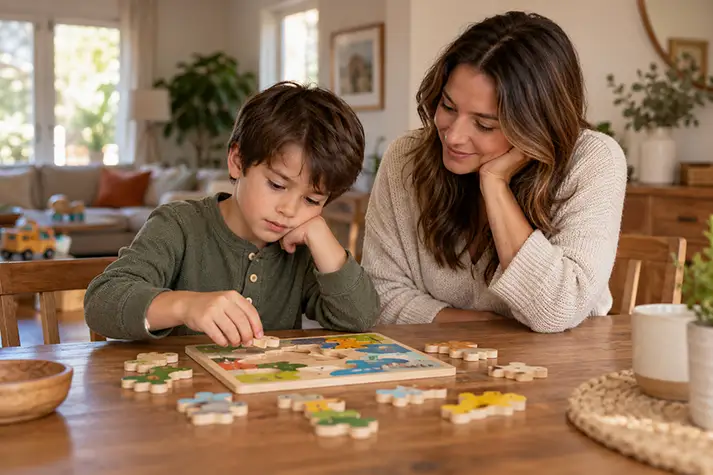
“I can’t do it.” “This is too hard.” “You do it.” Those words can arrive during a puzzle, a zipper, homework, a new game, or a first attempt at making something. Adults often feel pulled toward one of two quick responses: solve the problem immediately or insist that the child keep trying. A more useful middle path is to make the challenge manageable, stay connected, and help the child choose a next step.
Persistence Is Not the Same as Pushing Through Everything
Persistence means staying engaged with a goal long enough to try, adjust, and learn. It does not mean ignoring pain, exhaustion, fear, confusion, or a task that is far beyond a child’s current abilities. The Center on the Developing Child at Harvard University notes that children are motivated by achievable goals: effort is needed, but success still has to be possible. A challenge that is too easy can be boring; one that feels impossible can shut effort down.
Before encouraging another attempt, ask what is making the task hard. Is the child missing a skill? Are the instructions unclear? Is the environment noisy? Are they hungry, tired, rushed, embarrassed, or worried about making a mistake? The answer determines whether they need practice, a smaller step, a different tool, a break, or adult help.
Try This Three-Part Response
“That feels hard right now. Show me where you got stuck. Would you like a hint, to do the first step together, or to take a short break and return?”
Start by Naming the Feeling, Not Arguing With It
“You can do it!” is meant to reassure, but it can miss what the child is communicating. If they feel overwhelmed, immediate contradiction may sound like the adult is not listening. Begin with observation: “The pieces keep slipping, and you’re frustrated,” or “You worked on that paragraph and do not like how it turned out.” Acknowledging frustration does not confirm that the task is impossible. It helps the child feel understood enough to think again.
Keep your voice and explanation brief. A child who is upset is unlikely to use a long motivational speech. Calm presence, a drink of water, movement, or a few quiet minutes may come before problem-solving. JKD’s guide to helping toddlers through big feelings offers more ideas for staying steady while holding limits.
Make the Next Step Visible
“Try harder” does not tell a child what to do differently. Shrink the task until a next action is clear. Turn the puzzle pieces face up. Hold the coat while the child starts the zipper. Cover the rest of a worksheet and look at one problem. Read the first line of the directions together. For a crowded bedroom, begin with books rather than “clean everything.”
The American Academy of Pediatrics describes this kind of support as scaffolding: an adult offers hints or prepares the situation, then leaves useful space for the child to act. Give the least help that makes forward movement possible. A question such as “What have you already tried?” or “Which part could you do first?” preserves more ownership than taking over.
Match Support to the Child’s Age
Babies and Toddlers
Persistence begins in short, everyday exchanges: reaching for a toy, fitting a shape, stacking blocks, or trying a spoon. Stay close, respond to signals, and let the child lead. If frustration is rising, move the object slightly closer, demonstrate once, or switch activities. Success may be a few seconds of renewed attention, not finishing the task.
Preschoolers
Use concrete choices: “Do you want to try the sleeve first or the zipper?” Model flexible language: “That tower fell. I’m going to make the bottom wider.” Preschoolers may repeat the same attempt because they do not yet see another strategy. Offer one clue, then pause long enough for them to use it. Play, art, dressing, and simple household tasks provide low-stakes practice.
School-Age Children and Tweens
Older children may protect themselves from embarrassment by dismissing a task before trying. Avoid public correction or comparisons. Ask whether the difficulty is understanding the goal, knowing how to begin, managing time, or worrying about the result. Help plan a short work period and a check-in point. With schoolwork, adults can support organization and communication, but should not complete the child’s work.
Notice Strategies More Than Traits
Broad praise such as “You’re so smart” can make mistakes feel threatening: if success proves intelligence, what does struggle mean? Use specific, truthful feedback about what the child did. “You rotated the piece and checked both corners.” “You asked for clarification instead of guessing.” “You took a break and came back.” This information helps the child identify actions they can use again.
Do not praise endless effort when a strategy is not working. Help the child evaluate: “You have tried the same way three times. What could we change?” The goal is flexible persistence—trying, noticing, and adjusting—not proving worth through struggle. JKD’s article on independent play includes related ideas for stepping back without disappearing.
Use Choices and Natural Purpose Instead of Bribes
Some tasks are not optional, but children can often have agency over how they happen. They might choose which shoe to put on first, where to begin a chore, what materials to use, or whether an adult watches or checks back later. Harvard’s motivation guidance notes that children are more engaged when they have some self-determination and when goals are meaningful and achievable.
Rewards can sometimes produce quick cooperation, but promising a prize for every difficult moment may shift attention away from curiosity, contribution, or mastery. Whenever practical, connect effort to its purpose: packing a bag makes tomorrow’s morning smoother; practicing a skill makes a desired activity easier; putting materials away protects a project and shared space.
Let Children See Adults Revise and Recover
Adults can narrate ordinary problem-solving without turning every moment into a lesson: “I used the wrong lid. I’ll check another size.” “I sent that message too quickly, so I need to correct it.” Avoid harsh self-talk such as “I’m terrible at this.” Children learn that mistakes are workable when they see adults pause, change course, ask for help, and repair errors.
Know When to Pause or Seek More Support
Stopping can be wise. Pause when the child is becoming more distressed, the task is unsafe, basic needs are unmet, or continued effort is no longer productive. Agree on what returning will look like: after snack, tomorrow morning, or with a different adult. Some activities can also be set aside permanently when they are optional and no longer meaningful.
Talk with a pediatrician, teacher, or another qualified professional when difficulty is persistent across settings, interferes with everyday participation, or comes with significant distress. Ask what they observe and what supports have already helped. This article cannot determine why a particular child struggles; it offers a framework for responding without shame or pressure.
Build the Habit One Manageable Challenge at a Time
Children do not become persistent because adults never help, and they do not gain confidence from being rescued from every hard moment. They build it through repeated experiences of being understood, receiving just enough support, trying a useful strategy, and discovering what comes next. The everyday message is simple: difficulty is information, help is available, and one imperfect step still counts.