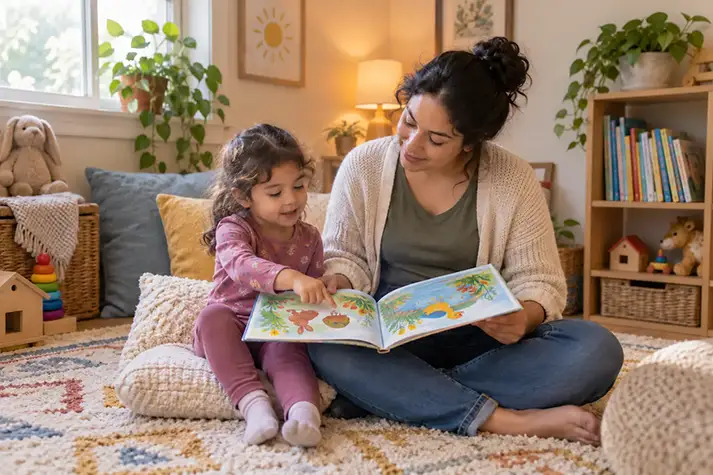
For many preschoolers, reading aloud is less about sitting perfectly still and listening from beginning to end than it is about sharing attention with a trusted adult. A child may point, interrupt, repeat a favorite line, turn back three pages, or wander away and return. Those moments are not failures. They are often the conversation that makes a book meaningful.
The American Academy of Pediatrics encourages interactive reading with young children. Shared reading can support language, early literacy, relationships, and social-emotional development. It does not require expensive materials, a formal lesson plan, or a child who already recognizes letters. A book, a few unhurried minutes, and an adult willing to notice what interests the child are enough to begin.
Start With Connection, Not Performance
It is easy to turn story time into a test without meaning to. “What color is this?” “What letter is that?” “Do you remember what happened?” Questions can invite participation, but too many right-or-wrong questions may make reading feel like work. Begin with connection instead: sit where both of you can see the pictures, follow the child’s gaze, and respond to what they notice.
Try comments such as “That dog looks surprised,” “You found the tiny caterpillar,” or “This part reminds me of the rain we saw yesterday.” Then pause. A child may answer with words, a gesture, a sound, or another observation. Conversation does not need to follow a script.
Choose Books a Child Can Enter
The “best” book is one the child wants to explore. Preschoolers often enjoy familiar routines, humor, repetition, predictable phrases, expressive pictures, animals, vehicles, family stories, and topics connected to their current interests. A child who is fascinated by construction equipment may talk far more during a simple truck book than during an award-winning story chosen by an adult.
Offer a small choice: “Would you like the animal book or the bedtime book?” Two or three options are usually easier than an entire shelf. Include books that reflect the child’s family, culture, home language, abilities, and everyday experiences, along with books that introduce people and places beyond the child’s own life.
Books do not have to be long. Photo books, wordless picture books, nursery rhymes, simple nonfiction, and books with repeated lines can all create rich conversation. Wordless books are especially flexible because the adult and child can build the story together from the illustrations.
Make Reading a Back-and-Forth Conversation
Federal Head Start shared-reading guidance describes dialogic reading as an interactive approach in which adults invite children to take an active role. In practice, that can be simple: notice, ask, listen, respond, and add a little more language.
A Useful Five-Step Rhythm
- Notice what the child is looking at or pointing toward.
- Invite a response: “What do you think is happening?”
- Wait long enough for the child to answer without rushing.
- Respond to the child’s idea, even when it is unexpected.
- Expand slightly: “Yes, a yellow bird is splashing in the water.”
Not every page needs a question. Mix prompts with comments, reactions, sound effects, and quiet looking. Questions beginning with what, how, or why can encourage longer responses, but questions connected to the child’s experience can be just as useful: “Have you ever felt nervous like that character?”
If a child gives an answer that does not match the picture, stay curious before correcting. The child may be making an imaginative connection you did not see. When correction is useful, keep it gentle: “I thought it was a fox at first, too. I see antlers, so I think this one is a deer.”
Let Repetition Do Its Work
Adults sometimes tire of a favorite book long before a child does. Repeated reading helps a preschooler become familiar with the story, anticipate what comes next, join in with repeated language, and notice details missed before. Familiarity can also free the child to talk more because less effort is needed to follow the plot.
Change the conversation on later readings. One day, focus on the pictures. Another day, act out a character’s movement, predict the ending, find a repeated object, or connect the story to something that happened at home. You do not need to invent a new activity every time; simply leave space for the child to notice something new.
When a Child Will Not Sit Still
Movement is common at preschool age. Try reading after active play, during a snack, while the child holds a quiet object, or in a cozy place with fewer distractions. Let the child stand, lean, or turn pages if the arrangement is safe and the book can still be shared.
Short reading moments count. Finish one page, describe one picture, or read for three minutes and stop while the experience is still pleasant. A child may also listen while building nearby, even when eye contact is brief. If every reading attempt becomes a struggle, reduce the pressure and try a different book, time, or format.
Keep Screens From Replacing the Conversation
Digital books can be convenient, but animations, games, and automatic narration may compete with the back-and-forth exchange. When using an e-book, choose a simple format, silence unnecessary effects, stay with the child, and talk about the story. The relationship and conversation are the important parts, whether the page is paper or digital.
Use the Language That Feels Natural
Families do not need to replace a home language with English during story time. Talk, read, retell, sing, and describe pictures in the language that allows the richest, warmest conversation. If a book is written in English but an adult is more comfortable in another language, the adult can discuss the pictures or retell the story in that language. Strong conversation and shared enjoyment matter more than performing every printed sentence exactly.
Build a Routine That Fits Real Life
A dependable reading habit does not have to happen only at bedtime. Try a book after breakfast, before leaving for childcare, during a quiet afternoon transition, or while dinner finishes cooking. Keep a few books within the child’s reach and rotate them occasionally so familiar favorites remain available without making the choice overwhelming.
Local families can borrow books and explore children’s resources through the Greece Public Library. Check its current calendar before visiting because program times and registration requirements can change. Library visits can help families follow a child’s changing interests without continually buying new books.
Share Reading Interests Across Home and Childcare
Tell your childcare provider about a book, character, rhyme, or topic your child currently loves. Ask what stories attract the child during care and whether the child tends to listen, point, repeat, act out, or retell. That information can help adults offer related words and experiences in both places without turning reading into assigned homework.
Families can learn more about preschool care at Jasmine’s Kingdom Daycare and browse other parent articles for practical routines and developmental guidance. Any description of a child’s current interests or participation should remain observational rather than becoming a judgment about ability.
Know When to Ask a Question
Children develop language and early literacy skills at different rates. CDC milestone checklists can help parents notice changes and prepare questions, but they cannot diagnose a child. Bring concerns to the child’s pediatrician if the child loses a skill, seems not to hear consistently, has difficulty communicating wants and needs, or if something about speech, language, interaction, or development worries you. Families do not need to wait for a crisis to ask for guidance.
Let the Book Be a Place to Meet
The goal of reading aloud is not to race through a stack of books or produce a preschooler who reads early. It is to make room for words, ideas, feelings, questions, laughter, and connection. Some days the child will listen closely; other days one funny picture may be enough. When adults follow the child’s interest, welcome participation, and return to books without pressure, reading can become a familiar place where conversation grows.